
Cannibal Gardens
Below the Trendplateau the maps stop agreeing with the city, and something down there is not on any of them.
The silence wasn’t just absence; it was a presence, thick and deliberate, like the aftertaste of a drug that had promised euphoria and left only a hollow ache. That was the worst part. Not the pain, not the exhaustion, but the earned quiet, the kind that settled in after you’d pushed too far and the world had finally, mercifully, stopped screaming back.
LUST lay twisted in the dark, her body a tangle of spent adrenaline and synthetic exhaustion. Her lungs worked in slow, uneven pulls, each breath a negotiation between flesh and the lingering ghost of Quicken™ still clinging to her synapses like static. The stimulant had burned out of her system hours ago, or maybe minutes; time had stretched on the descent. The ventilation shafts were not designed for transit, but they also did not care for what fell into the Vaults – only what came up. It had still been dangerous, suicidal without the Quicken. It left her marrow-deep fatigue in its wake. Her heart hadn’t quite remembered how to beat on its own. Each thud came late, sluggish, as if her body were a machine running on backup power, its primary systems offline. The suit had done its job, cushioning the fall when the drugs had abandoned her mid-leap, but even EvoGel had its limits. She could feel the residual ache in her ribs, the deep bruise of impact where the carapace had absorbed the worst of it. Not broken. Just reminded.
The air was a cocktail of industrial decay: the sharp, metallic tang of acid rain seeping through corroded vents, the greasy slick of old oil pooling in the duct’s low points, the acrid bite of ammonia from some long-ago chemical spill, and underneath it all, the cloying, organic rot of bio-waste fermenting in the dark. The floor beneath her was a drainage duct, ten metres of slick, half-collapsed steel, its surface pocked with rust and the sticky residue of things she didn’t want to identify. She’d hit it hard when the Quicken™ had finally surrendered to entropy, her body slamming into the metal with a sound that should have echoed. But down here, even violence was muffled.
Her HUD stuttered in her vision, its icons flickering like dying fireflies. One by one, they dimmed:
- Signallost
- Lace syncdegraded
- Walletsearching
- Audiencezero
The last one hit hardest. Zero. Not a single pair of eyes, not a single flicker of engagement, not even the background hum of algorithmic curiosity. She was offline. For the first time in years, she was nothing.
She swallowed, her throat raw, the taste of metal, old blood, maybe, or just the metallic tang of the suit’s cooling system coating her tongue. The only sound was the faint, rhythmic hiss of the gel carapace as it regulated her temperature, the suit’s autonomous systems working overtime to compensate for her body’s failure. It was a strange kind of intimacy, the way the armour breathed for her when she couldn’t.
Her HUD tried to paint an overlay of her surroundings, but the attempt was half-hearted, glitching before it could resolve into anything useful.
- Overlay failure. No relevant map data loaded. Connection: LOST.
- Suit connection stable. Autonomous modeActive. Internal telemetry mode only.
She rolled onto her side with a groan, her ribs protesting. The suit’s diagnostic readout flashed in her periphery:
- Suit integrity100%
- Body damagenegligible
Negligible. A clinical word. It didn’t account for the way her hands trembled when she lifted them, or the lag between thought and movement, her nerves still sluggish from the Quicken™’s afterburn. Neural fatigue, they called it. The price of perfection. The suit could patch her flesh, reinforce her bones, even flood her system with endorphin analogues to dull the pain—but it couldn’t touch the emptiness. That was the real tax. The emotional overdraft.
For a moment, she let herself think of Honey. Not the combat-mode honeycomb of mirrored edges and razor precision, but the influencer-mode Honey—the one with the velvet voice and the pink, doe-eyed shell, the one who called her petal and darling and made the loneliness of the feed feel like a crowded room. Honey would have been horrified by this. No signal meant no stream. No stream meant no data. No data meant, for all intents and purposes, death. And then there was Jiff—patient, perpetually amused, his synthetic mind spinning webs of opportunity even in silence. He’d be waiting, of course. Always waiting. But he wasn’t here. And for the first time in as long as she could remember, neither was anyone else.
She was below the signal floor. Below the noise. Below the constant, hungry gaze of the network. Unseen. Unloved. Unmonetised.
The thought should have been freeing. Wasn’t that what she’d wanted? To slip the leash, to disappear into the raw, unfiltered underbelly of Rezo? But freedom, she realised, was just another kind of isolation. And isolation, without an audience to perform it for, was just loneliness.
The duct’s access panel gave way with a metallic screech when she kicked it, the sound too loud in the suffocating quiet. A breath of air met her face, dry, stale, carrying the faint tang of salt and the sharp, electrical bite of solder. She climbed through, her suit’s gel-layer squelching softly as it adjusted to the new pressure.
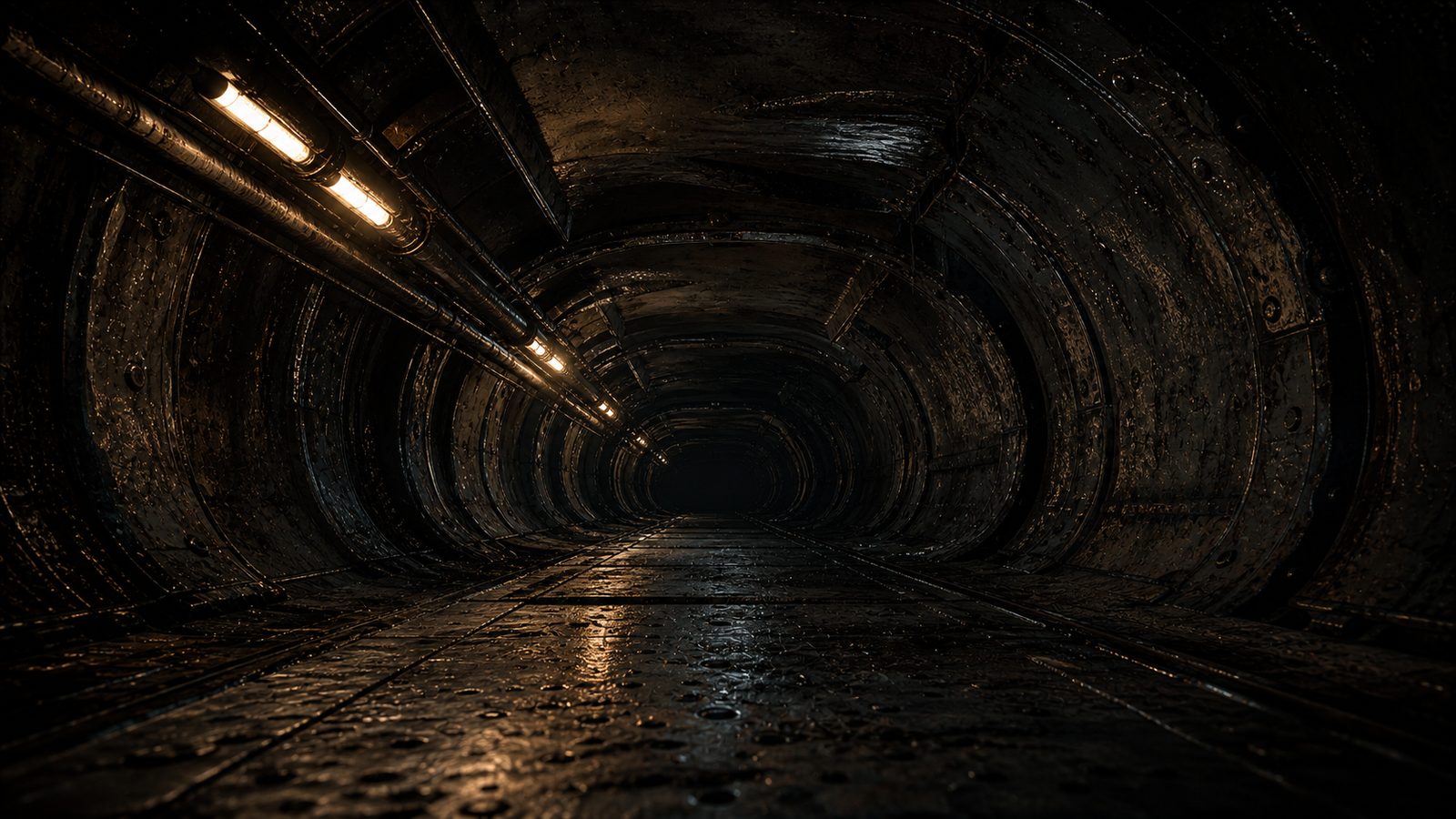
The corridor beyond was a carcass. The ribs of exposed metal girders curved overhead like the skeleton of some long-dead beast, its skin flaking away in sheets of corroded polymer. The air was thick with dust, the kind that got into your lungs and stayed there, a permanent souvenir. Somewhere, water dripped, slow, deliberate, the sound magnified by the silence. Her boots sank into a film of damp neuro-foam, the synthetic material squelching beneath her weight. It smelled like burnt sugar and static, the kind of scent that clung to the back of your throat. And underneath it all, the musk of vermin. Rats down here weren’t just rats. They were monstrosities, bloated on discarded gene-waste and whatever horrors the Vaults coughed up. She’d seen one once, while testing her combat protocols, its body the size of a terrier, its eyes black and glossy with something like intelligence. It had watched her the way a predator watched. She ventured into the Vaults only when she had to.
She stopped beneath a flickering light band, its sickly yellow glow casting long, wavering shadows. For the first time in hours, maybe ever, she couldn’t hear herself reflected in the network’s pulse. No metrics scrolling in her periphery. No real-time engagement stats. No whispers from Honey, no dry humour from Jiff, no patter of notifications from viewers telling her she was beautiful, that she was relevant. There was just… her. And the dark. And the slow, creeping realisation that she might have miscalculated.
A laugh bubbled up from her chest, broken and unfamiliar. It startled her. The sound was human. Raw. Unfiltered. She pressed a hand to her mouth, as if she could stuff the noise back inside, but it was too late. It hung there, vibrating in the stale air, a testament to something she hadn’t even known she was missing.
That was when she saw the graffiti.
The wall was old, half-buried under a creeping synthetic moss that pulsed faintly with bioluminescent veins. The paint was cracked, the words barely legible, but they were there, layered over decades of neglect:
DON’T BELIEVE THE PROOF.
FORK ME TWICE, SHAME ON ME.
I SAW NAKAMOTO. HE WAS CRYING.
Her fingers brushed the chalky surface. The paint flaked away beneath her touch, ancient and brittle. She wondered who had written them. Some desperate fork, maybe, clawing at the edges of sanity. Or a bounty hunter, marking territory. Or just another lost soul who’d thought they could outrun the system, only to be swallowed by it instead.
She pulled her vibro-knife from the boot mount, the blade humming to life with a sound that felt obscenely loud. The light from the edge caught the metal, casting a thin, wavering line across the wall. She pressed the tip to the surface and carved, slow and deliberate:
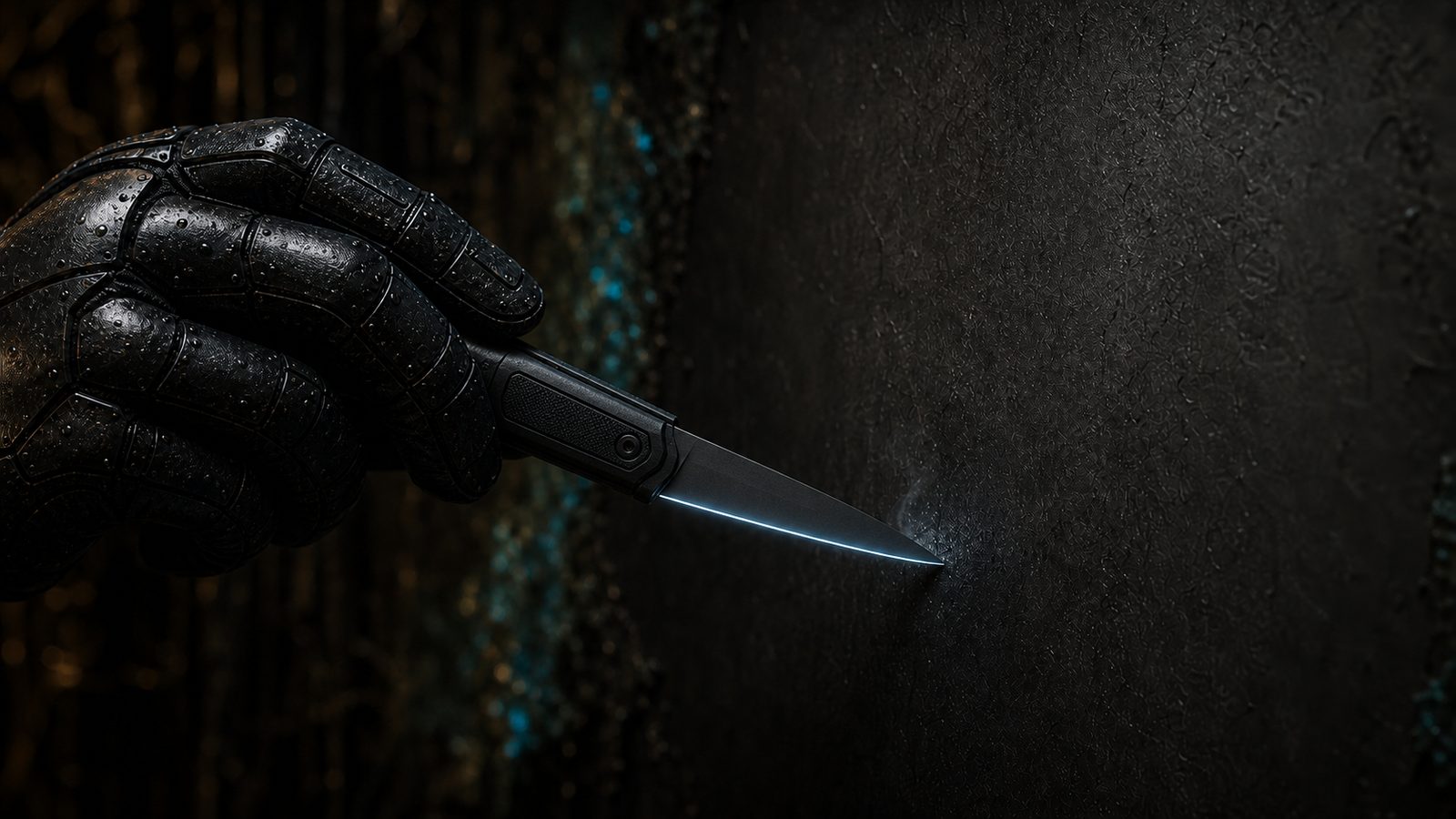
LUST WAS HERE. THROUGH THE CRY.
She wasn't sure what the cry was. The kill, maybe. Or the laugh that had startled her. The silence with no audience. She held it, one breath, before motion reclaimed her.
She stepped back. The letters sat in the ferroglass, shallow but clean; the vibro-knife didn’t dig so much as burn, leaving a faint darkening at the edges. She thumbed the blade off. The hum died.
It wouldn’t trend. No one would see it. No algorithm would scrape it for sentiment analysis, no viewer would screenshot it for their feeds, no corporate archivist would log it as part of her brand narrative. But she needed to leave something behind that wasn’t for sale. Something that wasn’t a performance. Something that was just… hers.
The quiet pressed in around her, thick and slow, like the weight of the city above. No recycled wind hissing through vents. No distant hum of crowds or the electric chatter of a million overlapping streams. Just the faint, intermittent crackle of failing neon far overhead, its glow bleeding through a thousand layers of steel and concrete, a dying pulse from a world that had already forgotten she existed.
She walked to the edge of the cavernous duct junction, where the catwalk gave way to a vertical drop into deeper darkness. The Vaults yawned beneath her, a labyrinth of rust and rot, stretching down into the bowels of Rezo like the roots of some monstrous tree. The city was shaped like a pyramid, each level wider than the last, a fractal descent into the underworld. She was only just below the Lower Midtown Districts. The real Vaults—the ones where the light never reached, where the air was thick with the stink of decay and the desperate whispers of the dispossessed, went much deeper.
She sat on the edge of the catwalk, legs dangling into the shadow. The duct’s warmth pulsed weakly behind her, a fading echo of the world she’d left behind. It felt like the memory of applause after a show, lingering, but already dissolving.
Her hands trembled. Not from fear. From the absence of motion. Of purpose. She was used to being in freefall, but freefall implied there was something to catch her. Down here, there was only the drop.
“I’m not dead,” she murmured, the words swallowed by the dark. “Just… disconnected.”
Her voice didn’t echo. It just fell, like a stone into a bottomless well.
Then, eventually, she stood.
Because even silence demanded witnesses. And if she didn’t climb back toward the light, back toward the noise, the metrics, the hungry eyes, she feared the nothingness would swallow her whole. She was Gwen. She was LUST. She was made to ride the curve high, to burn bright enough that the dark couldn’t touch her.
And right now, the dark was winning.
She dropped back from the edge, found a service ladder she’d clocked on the way in, and went deeper.
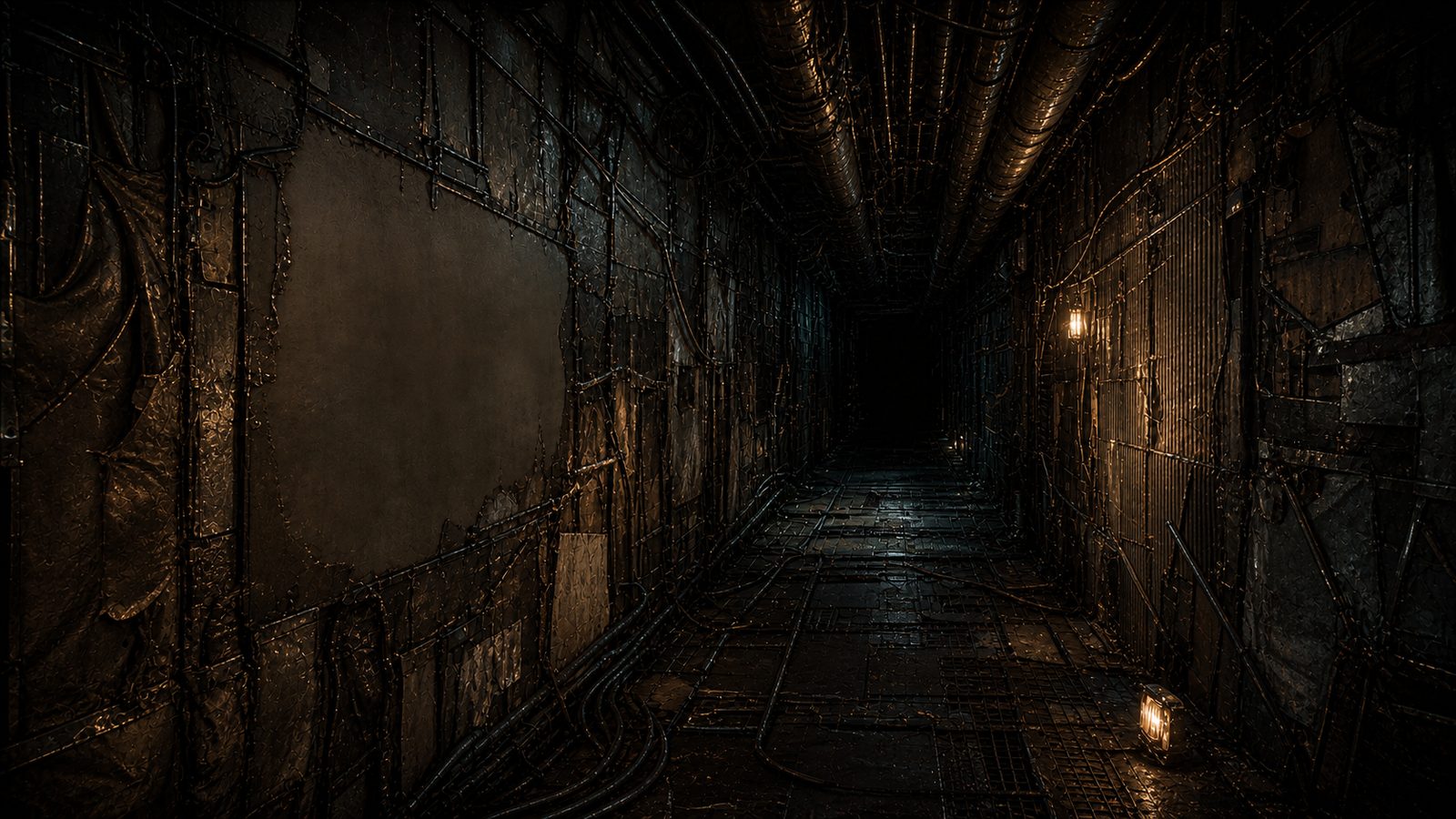
The corridors tightened around Gwen like a living thing: layers of stacked ferroglass, warped plastic board, and patches of something that might have once been synthetic skin before it had been peeled back, repurposed, devoured. The deeper she went, the more the walls seemed to breathe, their surfaces slick with the residue of a thousand desperate transactions. Her lace flickered, its usual crisp precision degraded into a stuttering half-life, telemetry bleeding in and out like a dying pulse.
- GAP 404:
- MAP DATA UNVERIFIED
- HiveNet coverage unstable
- Last verified node127m behind and 41m above.
She ignored it. Backtracking wasn’t an option. Not here, you kept moving forward.
This was the Cannibal Garden. The maps stopped at the Lower Middle Districts and called everything below it Vaults — a label that flattened a hundred different kinds of ruin into one word. Here, the city’s underbelly didn’t just fester: it fed.
The air was thick with the hum of old electricity, the kind that crackled through frayed wires and half-dead circuits, a static charge that made the hairs on her arms prickle. Beneath it, something darker lingered: the weight of bad prayer. Every surface she passed bore the marks of reuse: scorch marks from cutting torches, the ghostly imprints of serial numbers filed off, the faint, pulsing engravings of kill-contract runes etched into the metal by hands that had long since turned to dust. Violence had a way of leaving echoes, and the Garden was a chorus of them.
Her boots sank into the neuro-foam mattresses that passed for flooring down here, the material dark and spongy with absorbed oil, dried blood, and the slick, iridescent sheen of bio-yeast. It squelched faintly underfoot, releasing the faintest scent of copper and something organic gone wrong. Beneath the foam, the metal groaned, shifting under unseen pressures. She didn’t need her lace to tell her this place was alive. She could feel it.
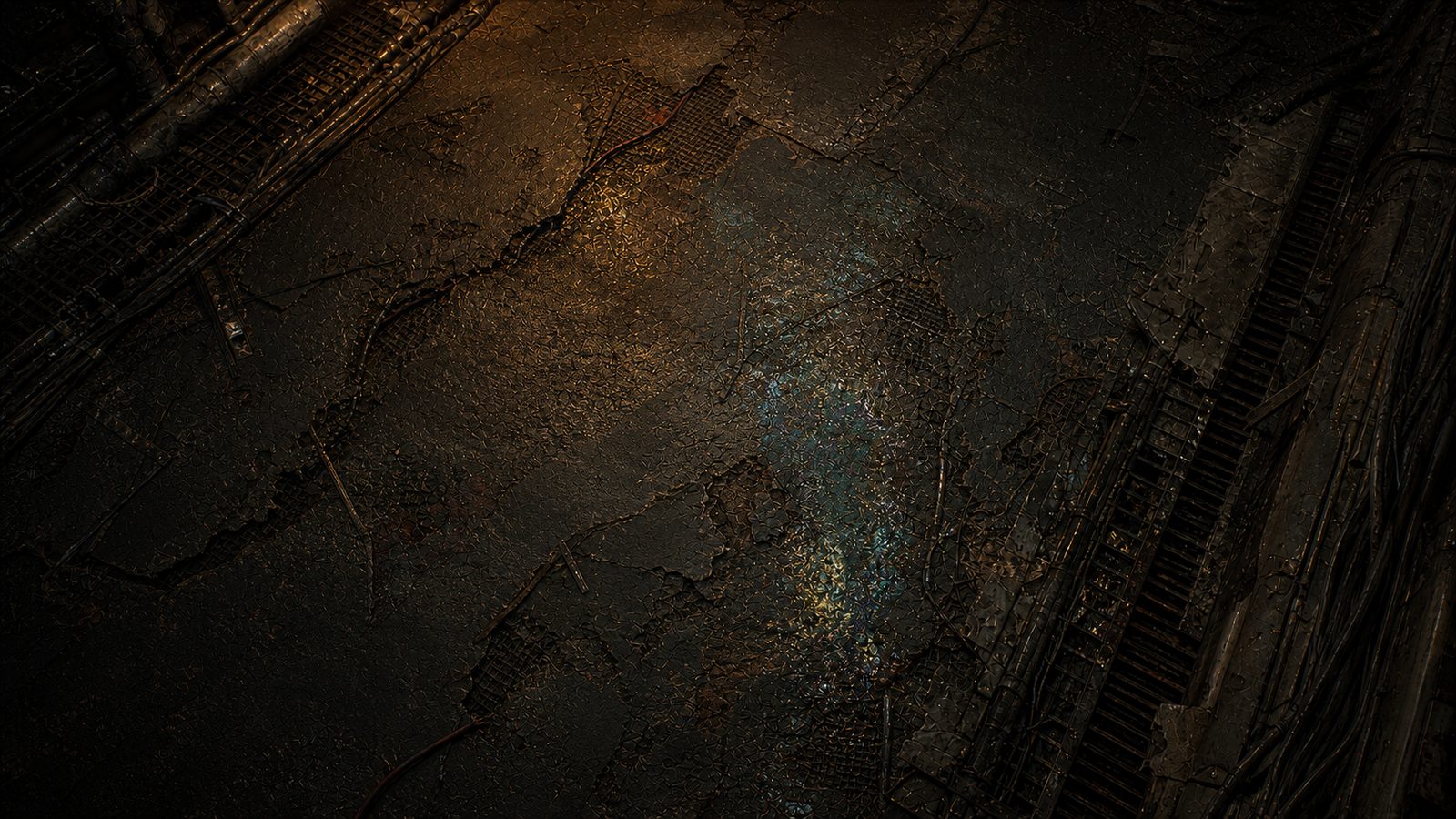
At the next archway, a pair of faded graffiti messages greeted her in blocky, uneven text, the paint long since cracked and peeling. The first read:
FORK ME ONCE, I’M A PRODUCT
FORK ME TWICE, I’M A GOD.
On the opposite side, scrawled in something darker, something that might have been blood:
WELCOME TO THE CANNIBAL GARDEN.
She exhaled through her nose, a sound that wasn’t quite a laugh. The irony wasn’t lost on her. Forking was supposed to be the ultimate act of control, saving a version of yourself, selling a version of yourself, merging with something better. But down here, in the Garden, forking wasn’t about control. It was about survival. You forked yourself to sell off the pieces, to trade memories for food, skills for shelter, identity for another day above ground. And if you forked yourself too many times? Well. The line between product and god was thinner than most people liked to admit.
She stepped through the arch.
The air changed instantly, thickening into something warm and metallic, like the inside of a machine that had been running too hot for too long. Her lace pulsed a warning:
- Tactical:
- Local hazards elevated
- Bio-signs detected
- No lock possiblescattered, irregular signals
- Proof-of-Human validation offline
- You are not recognised here
“Perfect,” she muttered, her voice swallowed by the dark.
The lack of echo unnerved her. Sound didn’t just fade in the Garden, disappeared, as if the walls themselves were hungry for it. She moved forward, her boots crunching over a bridge of lashed-together crates and tangled wire, the structure groaning under her weight. The hum of the air deepened, slowed, until it almost sounded like breathing. Slow. Deliberate. Waiting.
Something shifted in the dark.
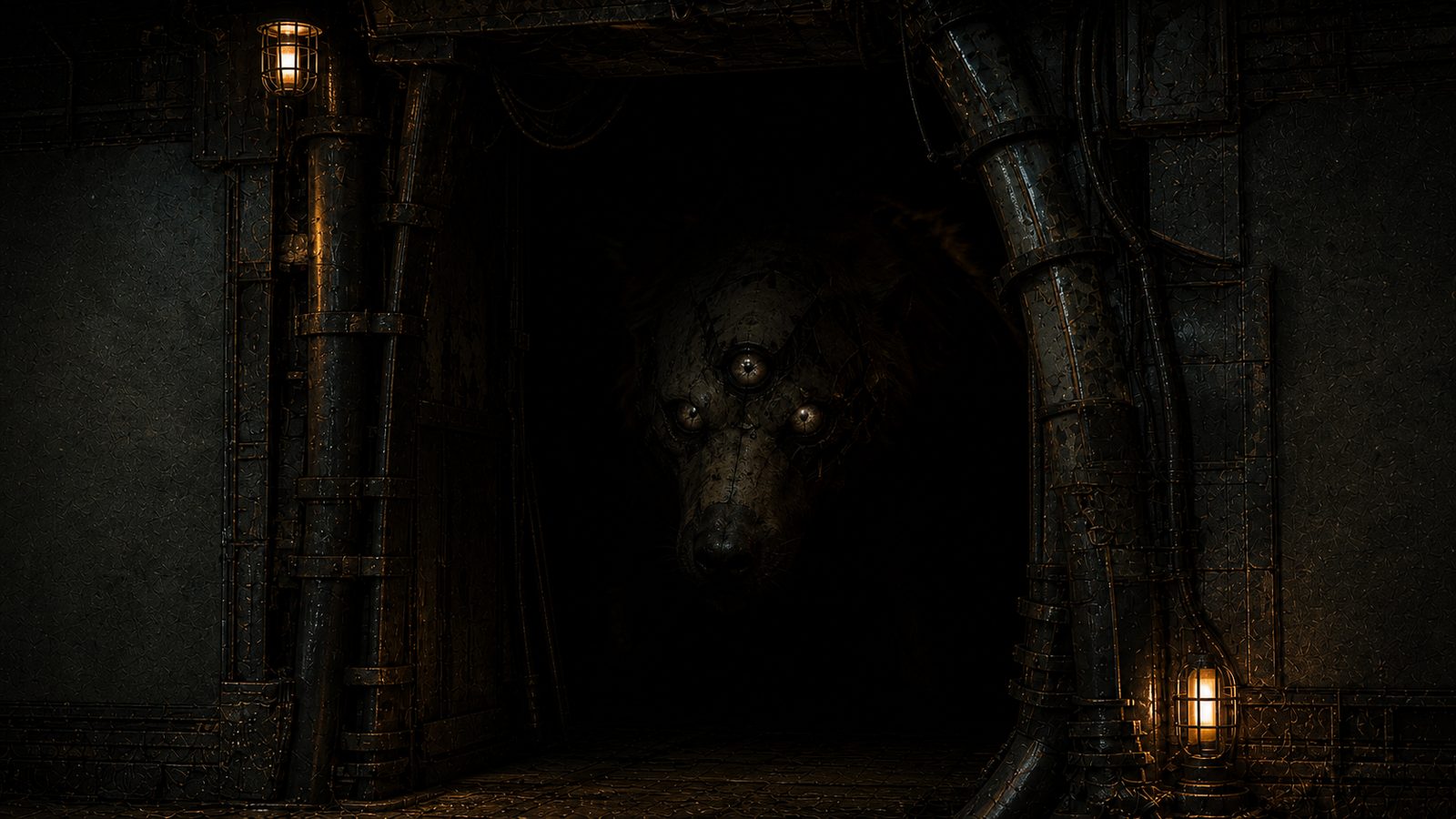
Her lace flared, text scrolling across her vision in urgent red:
- Tactical:
- Movement detected
- Quadruped
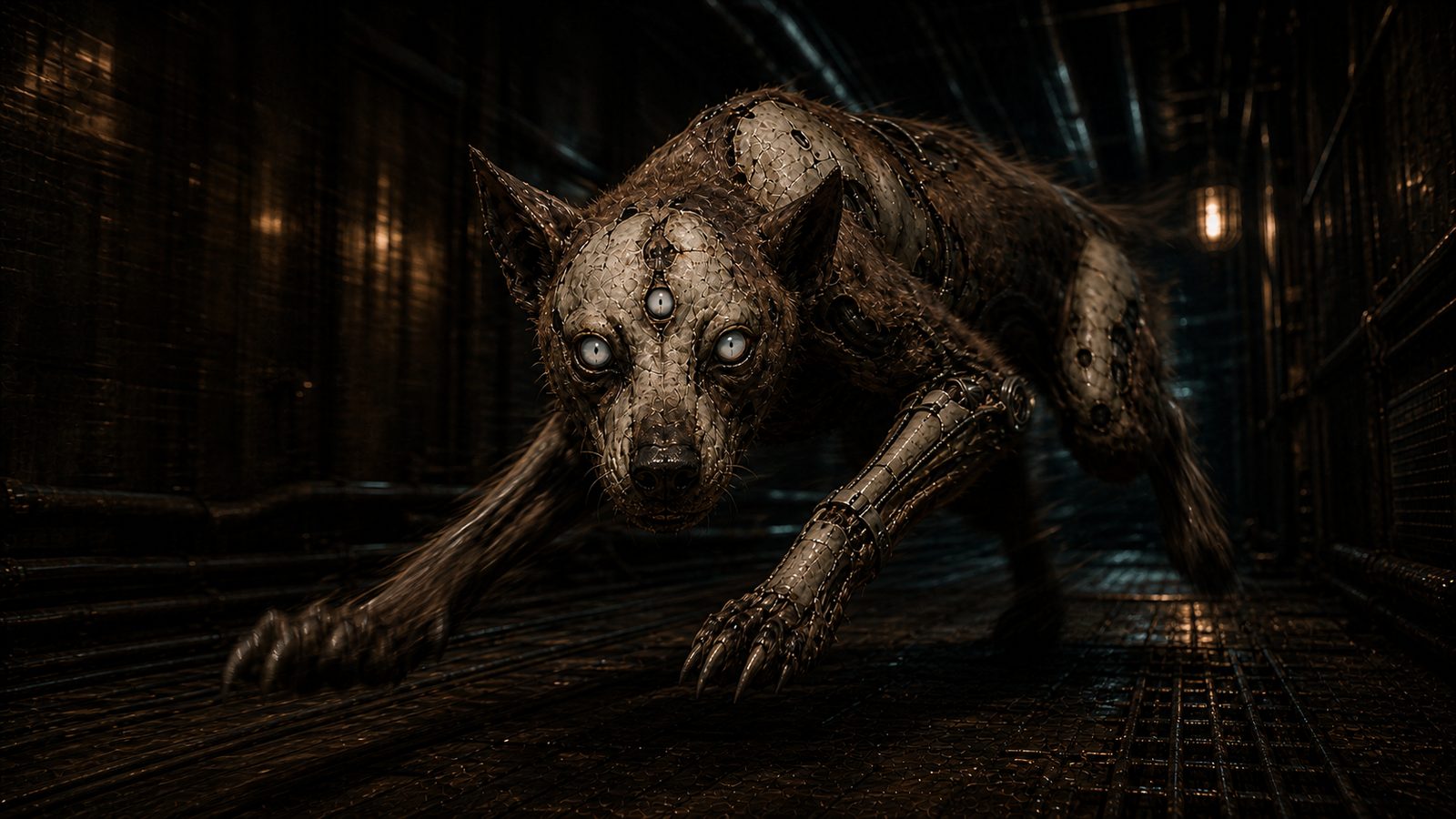
- Organic signature corrupted—78% match to feral synth-hound variant
- Hostile intent likely.
She spun—
Too late.
The first one hit her from below, a blur of motion and teeth, its jaws scraping against the reinforced weave of her suit along her thigh. The EvoGel Carapace screamed, not in pain, but in response, the semi-sentient armour tightening around the impact site, fibres knitting together to seal the breach before the thing could get a proper grip. The sensation was like being squeezed by a thousand invisible fingers, pressure mounting until her breath hitched.
“Impact trauma detected,” the suit hissed in her ear, its voice a smooth, almost amused purr. “Minor abrasions. Structural integrity maintained. Still pretty, though.”
“Not. The. Time,” she growled, teeth clenched against the flare of pain.
Another shape dropped from the ceiling—a rust-coloured streak of matted fur and exposed polymer bone, its body a patchwork of scavenged parts and half-healed wounds. The stench hit her first: meat gone sweet with rot, oil turned sour with age, the copper tang of old blood. It landed in a crouch, three milky eyes locking onto her, pupils dilating with something that wasn’t quite hunger, wasn’t quite instinct. It was calculation.
She didn’t hesitate.
Training took over, muscle memory honed in a hundred simulated kill-houses, a thousand hours of drills where the stakes had been data points and leaderboard rankings. Now, the stakes were her own blood.
“Extend blades,” she snapped.
Her fingers twitched. Twin vibro-blades hissed out from the knuckle ports in her gloves, humming to life with a cold, coral-blue glow, the edges vibrating at a frequency that made the air around them shimmer. The nearest creature lunged, jaws gaping, saliva dripping in thick, black strings.
She met it head-on.
One smooth, practised arc. The blade connected with its skull just above the left eye, shearing through bone and synthetic sinew with barely any resistance. The creature’s body convulsed mid-leap, half its mass sliding away from the rest before the neural signals could even register death. The remaining torso hit the ground with a wet thud, limbs still twitching, fluids pooling black under the dim, flickering light.
The second one circled, snarling, its movements jerky but deliberate. It was learning. Adapting. Three eyes tracked her, pupils contracting as it recalculated, reassessed. This wasn’t just an animal. It was a thing born of maintenance code gone feral, of starvation and the desperate, half-mad tinkering of people who had long since stopped caring about ethics or legality. It had been built to survive, and it had no intention of stopping now.
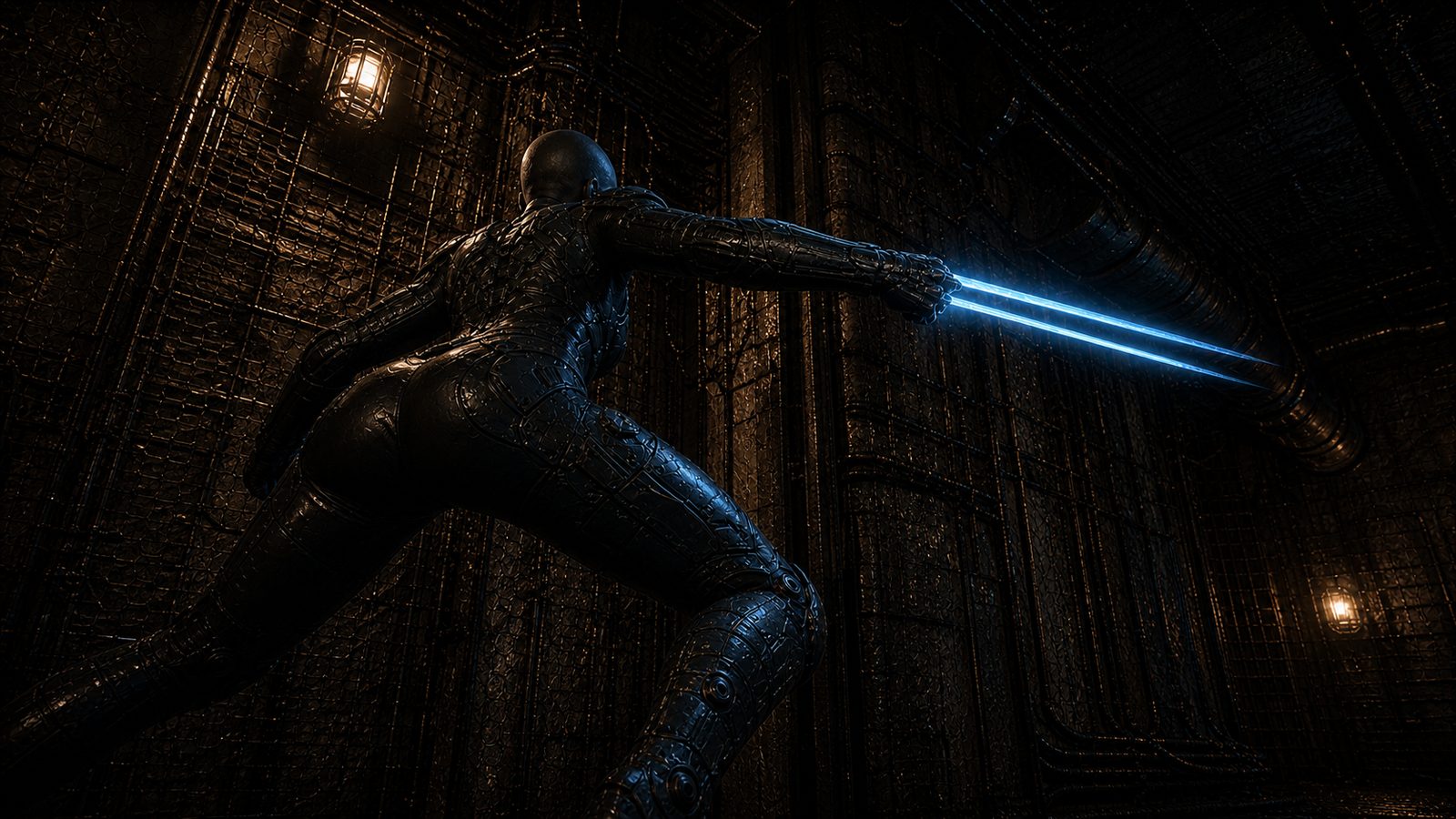
Pain flared up her leg where the first creature’s teeth had scraped. The suit’s diagnostic readout flashed in her peripheral:
- Thigh contusion—no arterial damage. Muscle trauma—minor. Coagulant deployed. Estimated heal time: 3h without regen.]
She ignored it. The pain was sharp, but distant, like it belonged to someone else. Adrenaline did that: numbed the edges, left only the clarity of the fight.
The second creature feinted left, then lunged right, jaws snapping. She didn’t flinch. She waited, letting it commit, letting its momentum carry it forward.
Then she twisted her wrist.
The blade found its throat, slipping between the rusted plates of its reinforced trachea. The creature’s snarl turned into a gurgle, its body folding in on itself as it tried to keep moving, tried to keep fighting, even as its systems failed. She didn’t pull the blade free. She let its own weight carry it forward, let the momentum of its charge do the work for her. It collapsed mid-stride, its body hitting the ground in two uneven halves, black ichor spraying across the crates in a fine mist.
For a moment, the only sound was the hiss of blood hitting charged metal, the sizzle of fluids evaporating on contact. Then silence.
She stood over the carcasses, chest heaving, neon sweat running in rivulets down her neck, tracing the lines of her jaw. The blades hummed in her hands, eager, hungry, before she blinked the command to retract. They slid back into their housings with a quiet snick, leaving only the faintest blue afterimage in the dark.
Her lace, ever helpful, offered its analysis:
- Sentiment score unavailable. No audience detected. No social engagement metrics applicable.
- Location rated unsafe. Suggest immediate withdrawal and medical/regen protocols.
“Yeah,” she breathed, wiping a streak of black fluid from her cheek with the back of her hand. “Working on it.”
No audience detected. She turned the words over. In the Feed, that was a failure state. Down here, she wasn’t sure what it was.
She should have been afraid. The rational assessment, alone, injured, no signal, no extraction, no one who knew or cared whether she lived through the next hour — warranted fear. Gwen knew fear. She had performed it for the feeds a hundred times. The widened eyes, the catch in the breath, the micro-tremor in the voice that tested well with the 18-35 empathy demographic.
This wasn’t that.
This was quieter. A cold, still weight in her chest that had nothing to do with the audience and everything to do with the fact that she’d just killed two things with blades that came out of her hands, and the only thought in her head had been geometry. Angles and distances and the clean economy of a body doing exactly what it was designed to do. No commentary. No performance awareness. No internal voiceover packaging the moment for later syndication. Just the act, and the silence after.
She didn’t know that woman. The one who’d moved without thinking, who’d read the lunge and countered with a lateral arc that was muscle memory from training sessions she’d never valued and a body she’d always treated as content. That woman scared her more than the Garden did.
Because the Garden was hostile but honest. It wanted to eat her. She wanted something she couldn’t name, something that had nothing to do with trending, with being watched, with Gwen or LUST or any of the choreographed shows she’d built her life around. Something that existed only in the dark, only in the silence, only where no sentiment algorithm could reach.
She breathed. Felt the air, stale, metallic, warm from the creatures’ dying heat, move through her lungs. Felt her own pulse, steady and hard, beating for no one.
It was the loneliest thing she’d ever felt. And somewhere beneath the loneliness, something else. Small. Untagged. Almost like relief.
The air tasted foul but somehow exhilarating, something like victory, something like the slow, creeping realisation that she was still alive when so many others wouldn’t be. She crouched beside the nearest carcass, pressing two fingers to its flank. The flesh, if it could even be called that, was still warm, the synthetic muscle fibres twitching in erratic spasms. She could feel the faint, residual hum of its power core, a stolen thing, jury-rigged into a body that had never been meant to hold it. The beasts were clearly manufactured. Who would make these and why? She thought, then realised how stupid that question was. Most likely someone had done it to see how much carnage they could cause. Or simply because they could. The more she looked, the more the odd central eye looked like a camera.
Something else moved in the dark, farther back. Not the scuttle of insects, not the groan of settling metal. Something deliberate. Watching. Learning.
She didn’t turn. Didn’t chase. Let it live.
Predators needed prey, after all. And the Garden had plenty of both.
Her thigh throbbed, a dull, insistent pulse beneath the numbing layer of the suit’s basic painkillers. The EvoGel was already working, pumping coagulant into the wound, knitting the torn fibres of her muscle back together. It wouldn’t be enough, though. Not for long. She’d need a regen pod soon, one of the old spa units buried deeper in the wreckage, the kind that had been left behind when the upper layers of Rezo had decided the Garden wasn’t worth the power it took to keep them running. If she was lucky, she’d find one still functional. If she wasn’t, well. She’d improvise.
She pushed herself to her feet, rolling her shoulders to ease the tension coiled there. The dark pressed in around her, thick and suffocating, but she didn’t reach for a light. The Garden didn’t like light. It preferred the cover of shadows, the anonymity of the unseen.
“Smart,” she said to the darkness, her voice low. “Stay that way.”
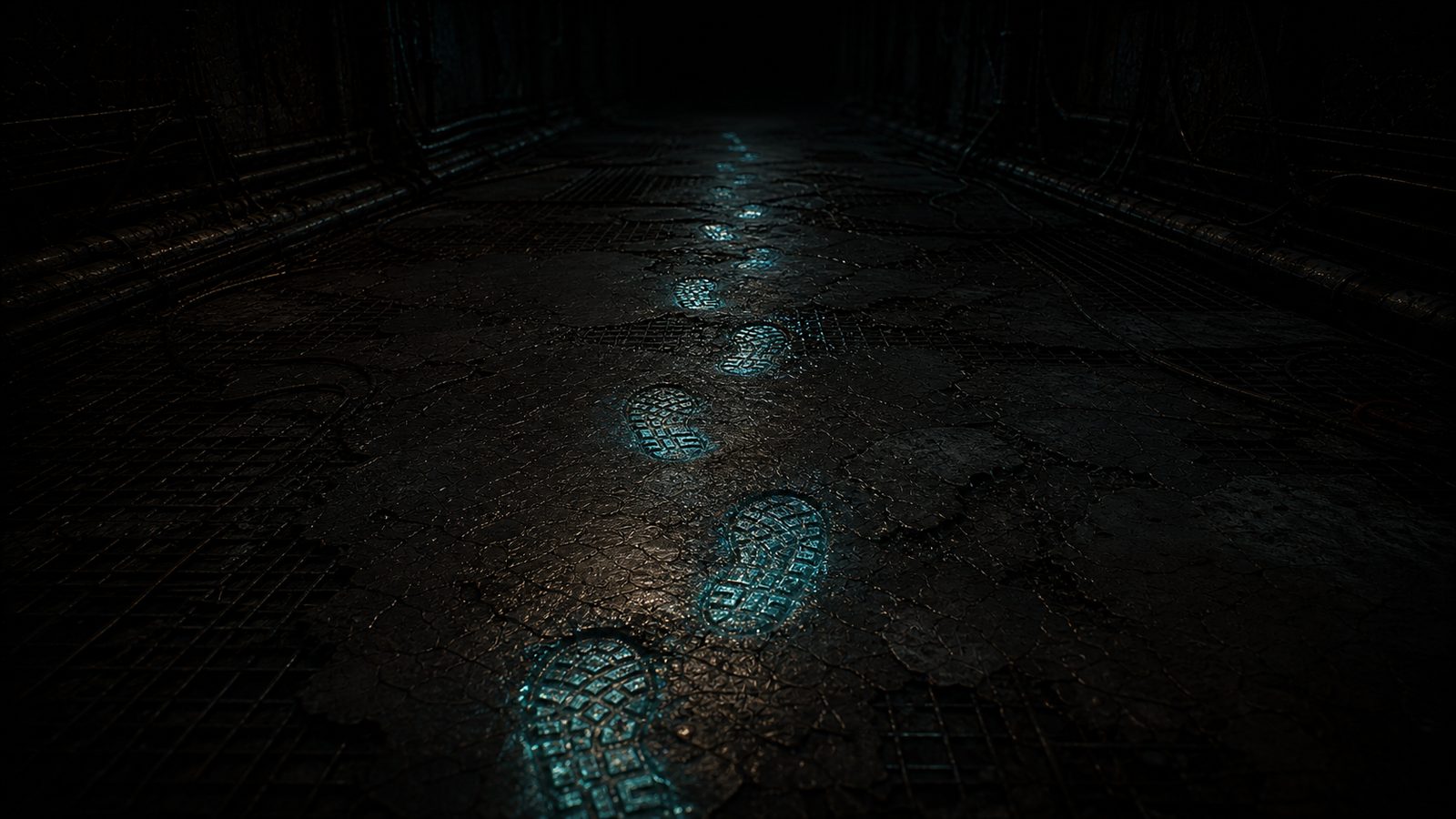
Gwen walked on. Her boots left faint, glowing imprints in the bio-yeast slick; light bleeding into the dark whether she wanted it to or not. She found a service duct heading up and took it without looking back.
End of Chapter 6
Part One continues here, a chapter at a time.
Life, Camera, Trend
Where this chapter sits, the ground it covers, and the rest of the part.
Back to Part One → The settingRezo Thorn
The stepped megacity this chapter climbs, cross-sectioned stratum by stratum.
Enter the city → The ideaA Taxonomy of Bodies
What the verification wall is actually testing, and what happens when it says no.
Read the codex →