
End of Part One
Life, Camera, Trend. Seven chapters, and the whole of them was a fall.
On the Necessity of Scarcity in a Post-Material World
A good has value in proportion to its scarcity relative to demand. This is not a law of nature about physical goods alone; it is a structural feature of any system in which value is determined by relative position rather than absolute quantity. When material goods become abundant, material goods lose their capacity to function as markers of relative position. They become too cheap, too available, too undifferentiated to carry the meaning-load that humans require their valued goods to carry.
The Narrative Economy is the institutional expression of this functional scarcity theorem. It is not a failure of the post-material transition. It is the economy that the post-material transition produced, because the post-material transition made material goods abundant and thereby made meaning goods scarce. The arena, the kill market, the experience-module: these are institutions that produce and price functional scarcity in a world where material scarcity has been abolished. They are not atavistic. They are structurally necessary.
[Abundance Is the Condition, Scarcity Is the Product], Foundational Economics Division. SUDR-1246.030.
Where Part One went
Seven chapters, read top to bottom, plotted against the city they fall through. Two of them go the other way.
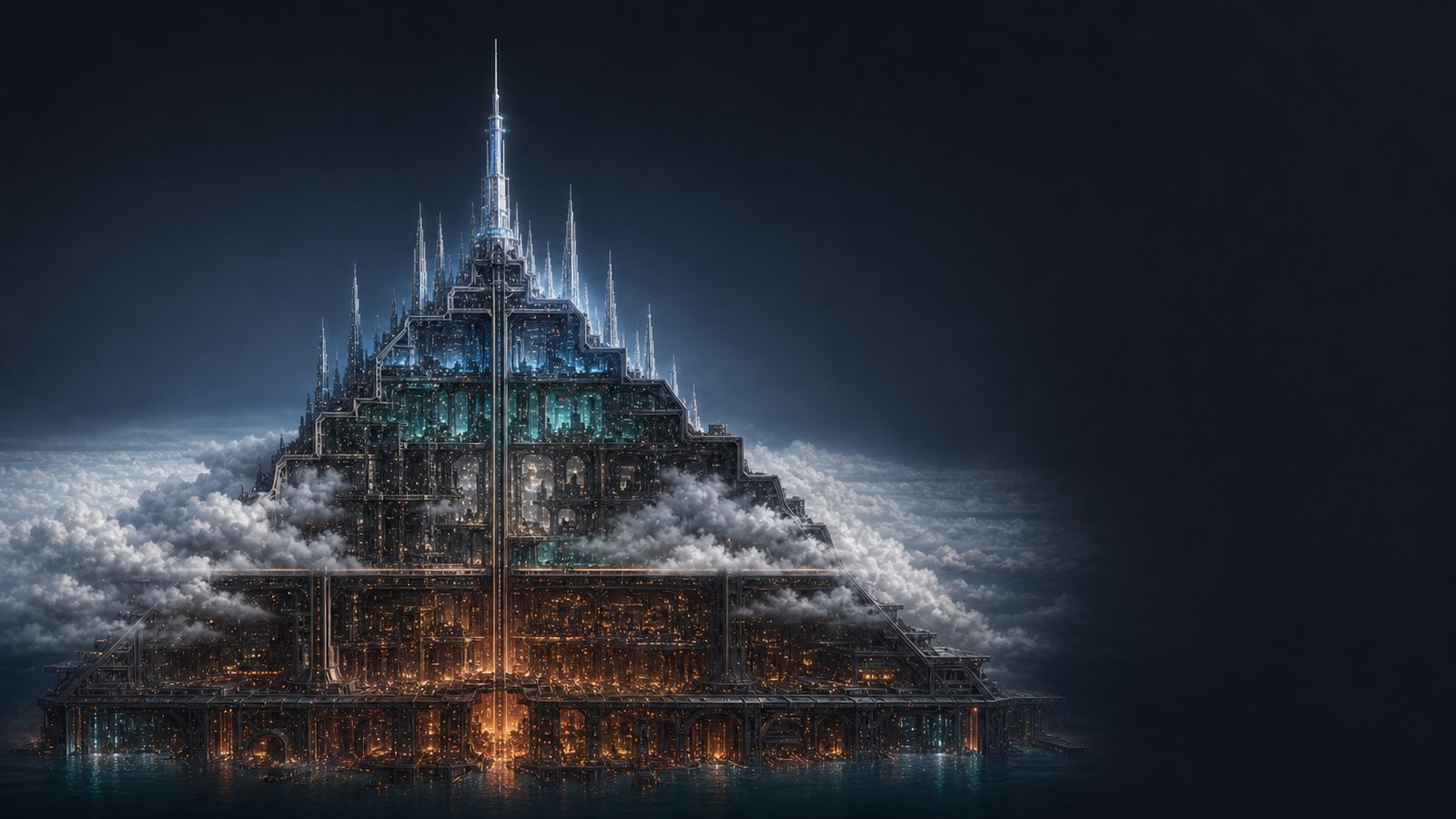
- 3 The Gardener Above the city · Geosynchronous orbit A call from an orbital greenhouse, and a bounty with teeth.
- 5 Crimson Enterprise Above the city · Orbit, and a desk far below A man who has no idea what kind of morning this is.
- 2 Heaven Apex Apex Heaven · L1723 – L1712 The Menagerie, where invitations are the currency.
- 1 Rising Heights Rezo Heights · L1321-S4 She wakes, performs, and proves she is human to a wall of black glass.
- 4 Bounty Brand The Trendplateau · L751-S46 Down at the cloud line, where the work is done and the feeds watch.
- 6 Cannibal Gardens The Upper Vaults · L724-S46 Off the maps entirely, and something down there is not on any of them.
- 7 Scrubbed Clean The Upper Vaults · L699-S72 A records error. The feed reports her death while she is still breathing.
What you just read
Part One was a fall. It opened at the top of the city, where Gwen woke in Opulence Tower and proved her humanity to a wall of black glass before breakfast, because in Rezo Thorn being watched is the same thing as being alive, and she was one of the most watched women in the corridor. Seven chapters carried her down: from the Menagerie at Heaven Apex, where invitations are currency; through a stranger’s face worn for an evening; to the cloud line at Sector 46, where LUST does her work and the feeds pay to watch; then off the maps entirely, into Cannibal Gardens, and below the signal floor into the Vaults. She climbed into a dying regen pod to be repaired, and woke to nothing. No wallets. No tokens. No identity verified. No hack, no crime, no trial: a records error, and the ledger simply let go of her. By 06:14 the morning feeds were reporting her death, warmly, with sponsors. She heard none of it. She was still breathing, and the system that decides what “alive” means had stopped agreeing.
Go back down slowly
You’ve made the descent once at story speed. These take it a level at a time.
Rezo Thorn
Every level she fell through, cross-sectioned: the Thorn from the Apex taper to the Vaults, stratum by stratum, with the addresses decoded.
A Taxonomy of Bodies
What the verification wall was actually testing all along, and now you have watched it say no, what that no really means.
The cast
Gwen and her weapon-self LUST, Jiff the Gardener, and Honey: who they are so far, kept spoiler-light.